
Somewhere between your discarded antibiotic capsule and the nearest river, a quiet chemical crisis is unfolding. Pharmaceutical residues — from antibiotics and painkillers to hormones and antidepressants — are accumulating in freshwater systems at measurable, biologically active concentrations. Yet the analytical tools traditionally used to detect them are expensive, laboratory-bound, and completely inaccessible to the communities most exposed to contaminated water.
Colorimetric sensors are changing that equation — transforming a complex analytical challenge into something as immediate and readable as a color change visible to the naked eye.
What Exactly Is a Colorimetric Sensor?
At its core, a colorimetric sensor is an analytical device that signals the presence of a target substance — a drug molecule, a heavy metal, a biological marker — through a visible, measurable change in color.
No sophisticated laboratory instrument is required. No mass spectrometer. No trained analytical chemist at the controls. Just chemistry doing what chemistry does best: responding to its environment in ways we can see, measure, and interpret.
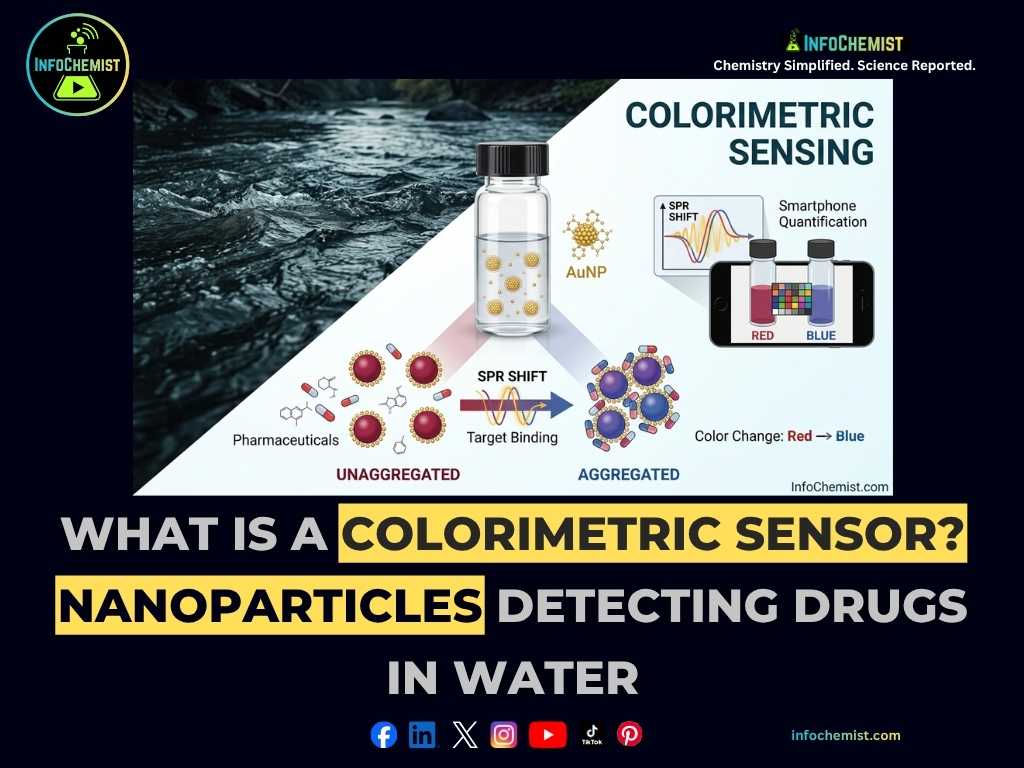
The underlying principle is elegant in its simplicity. When a sensing material — typically a nanoparticle, dye molecule, or functionalized surface — comes into contact with a specific target analyte, a chemical interaction occurs that shifts the wavelength of light the material absorbs or reflects. That shift registers as a color change, detectable either by the human eye or by a basic spectrophotometer.
⚡ Fast Facts
- What it is: An analytical tool that detects target substances through visible color changes
- How it works: A sensing material reacts with a target analyte, shifting light absorption and producing a measurable color change
- Why it matters: Enables rapid, low-cost pharmaceutical and environmental detection without laboratory infrastructure
- Key example: Gold nanoparticle-based sensors for antibiotic detection in water and pharmaceutical formulations
- Detection range: Modern colorimetric sensors routinely achieve sensitivity in the micromolar (μM) to nanomolar (nM) range
The Science Behind the Color Change
Gold Nanoparticles — Nature’s Most Sensitive Color Switches
Among all sensing materials available to analytical chemists, gold nanoparticles (AuNPs) have emerged as the most powerful and versatile colorimetric platform. And the reason is rooted in a phenomenon called Surface Plasmon Resonance (SPR).
When light strikes a gold nanoparticle, it causes the free electrons on the nanoparticle’s surface to oscillate collectively — a quantum mechanical dance that absorbs light at a very specific wavelength. For AuNPs dispersed uniformly in solution, this absorption peak sits at approximately 520 nm, producing the characteristic wine-red color that makes colloidal gold instantly recognizable.
Here is where the sensing magic happens: when a target drug molecule interacts with the nanoparticle surface — either through direct binding or through disrupting a stabilizing surface coating — the nanoparticles begin to aggregate. As they cluster together, their SPR peaks shift dramatically toward longer wavelengths, typically 600–700 nm, and the solution color shifts visibly from red to blue or purple.
Think of it like a crowd of people standing apart in a sunlit room versus huddling together in the corner. The distribution of bodies — or in this case, nanoparticles — fundamentally changes how light interacts with the whole system.
The Role of Surface Functionalization
Raw gold nanoparticles respond to many things indiscriminately. Selectivity — the ability to detect one specific drug molecule in a complex biological or environmental matrix — requires strategic surface engineering.
This is achieved through surface functionalization: coating the nanoparticle with molecules specifically designed to interact with the target analyte. Common surface agents include:
- Polyethylene glycol (PEG) — improves stability and biocompatibility while controlling surface interactions
- Aptamers — short DNA or RNA sequences that fold into specific three-dimensional shapes to bind target molecules with high affinity
- Antibodies — biological recognition molecules offering exceptional target specificity
- Thiol-based ligands — chemically anchored to the gold surface via the strong Au-S bond, providing controlled surface architecture
Why Detecting Drugs in Water Matters
The Pharmaceutical Pollution Crisis
Pharmaceutical contamination of aquatic environments is one of the most underreported environmental chemistry crises of our time. A landmark global study published in Science analyzed water samples from 258 rivers across 104 countries and detected measurable pharmaceutical concentrations in 72% of samples, with the highest contamination levels recorded in low- and middle-income countries with limited wastewater treatment infrastructure.
The consequences are not merely chemical. Antibiotic residues in waterways — from drugs like cephalexin, amoxicillin, and ciprofloxacin — actively promote the development of antibiotic-resistant bacteria, contributing to one of the most urgent global health threats of the 21st century. Endocrine-disrupting compounds from hormonal medications alter reproductive biology in aquatic organisms at concentrations as low as nanograms per liter.
Yet conventional detection methods — HPLC, LC-MS/MS, GC-MS — require centralized laboratory infrastructure, trained operators, expensive reagents, and processing times measured in hours to days. For a water quality inspector in a rural Pakistani village or a community health worker in sub-Saharan Africa, these methods are simply not accessible.
Colorimetric sensors bridge this gap — delivering analytical sensitivity competitive with laboratory instruments at a fraction of the cost, in a format deployable at the point of need.
Real-World Applications — From Lab Bench to Water Source
1. Pharmaceutical Quality Control
Before a drug reaches a patient, it must meet strict purity and potency specifications. Colorimetric sensors offer pharmaceutical manufacturers a rapid, in-line quality control tool capable of detecting active pharmaceutical ingredient (API) concentrations in real time during production — without interrupting the manufacturing workflow for laboratory analysis.
For antibiotic production facilities in particular, where potency verification is critical for patient safety, a colorimetric sensor that delivers results in minutes rather than hours represents a meaningful operational advantage.
2. Environmental Water Monitoring
Colorimetric sensors are increasingly being adapted for field-deployable water quality testing — monitoring rivers, groundwater sources, and treated wastewater effluents for pharmaceutical residues. Coupled with smartphone-based colorimetric readers that quantify color changes through camera analysis, these sensors bring laboratory-grade sensitivity to remote field conditions.
Researchers at multiple institutions have demonstrated colorimetric detection of common antibiotics — including cephalexin, tetracycline, and ciprofloxacin — in spiked river water and hospital effluent samples with detection limits reaching into the nanomolar range, well below the concentrations at which environmental harm occurs.
3. Clinical and Point-of-Care Diagnostics
Beyond environmental monitoring, colorimetric platforms are being developed for point-of-care clinical diagnostics — detecting disease biomarkers, pathogenic bacteria, and drug metabolites in blood, urine, and saliva samples. For healthcare systems in resource-limited settings, a colorimetric test that requires no electricity, no refrigerated reagents, and no laboratory infrastructure could fundamentally reshape early disease detection.
The Limitations — What Colorimetric Sensors Cannot Yet Do
Scientific honesty requires acknowledging where current colorimetric technology still falls short:
- Matrix interference: Complex real-world samples — river water containing organic matter, sediment, and competing ions — can interfere with colorimetric responses, reducing accuracy
- Multiplexing challenges: Most current colorimetric sensors target one analyte at a time; detecting multiple drugs simultaneously in a single test remains an active area of research
- Quantitative precision: While colorimetric sensors excel at rapid qualitative detection, achieving the quantitative precision of laboratory instruments requires careful calibration and controlled conditions
- Stability: Nanoparticle-based sensors can be sensitive to temperature, pH, and ionic strength — requiring careful formulation for real-world deployment conditions
These are not reasons to dismiss colorimetric sensing — they are the frontiers actively being pushed by researchers worldwide.
The Bottom Line — Chemistry You Can See
The colorimetric sensor represents one of chemistry’s most powerful ideas: making the invisible visible. By translating molecular-scale interactions — a drug binding to a nanoparticle surface, an antibiotic disrupting a colloidal assembly — into color changes observable without any instrument beyond a human eye, these platforms democratize analytical chemistry in ways that conventional laboratory methods never could.
For the billions of people living in communities where pharmaceutical water contamination is a real and growing threat, and where laboratory infrastructure remains out of reach, the colorimetric sensor is not just a scientific curiosity. It is a practical tool for environmental justice.
Want to go deeper into the synthesis, characterization, and analytical performance of gold nanoparticle colorimetric sensors — including UV–Vis spectroscopy data, AFM imaging, and FTIR characterization? Read our comprehensive technical breakdown at Universe of Chemical Sciences (UOCS).
Explore More at InfoChemist
Interested in how AI is accelerating the design of next-generation sensing materials? Read our analysis on AI in Chemistry to see how machine learning is transforming analytical chemistry from the molecular level up.
