
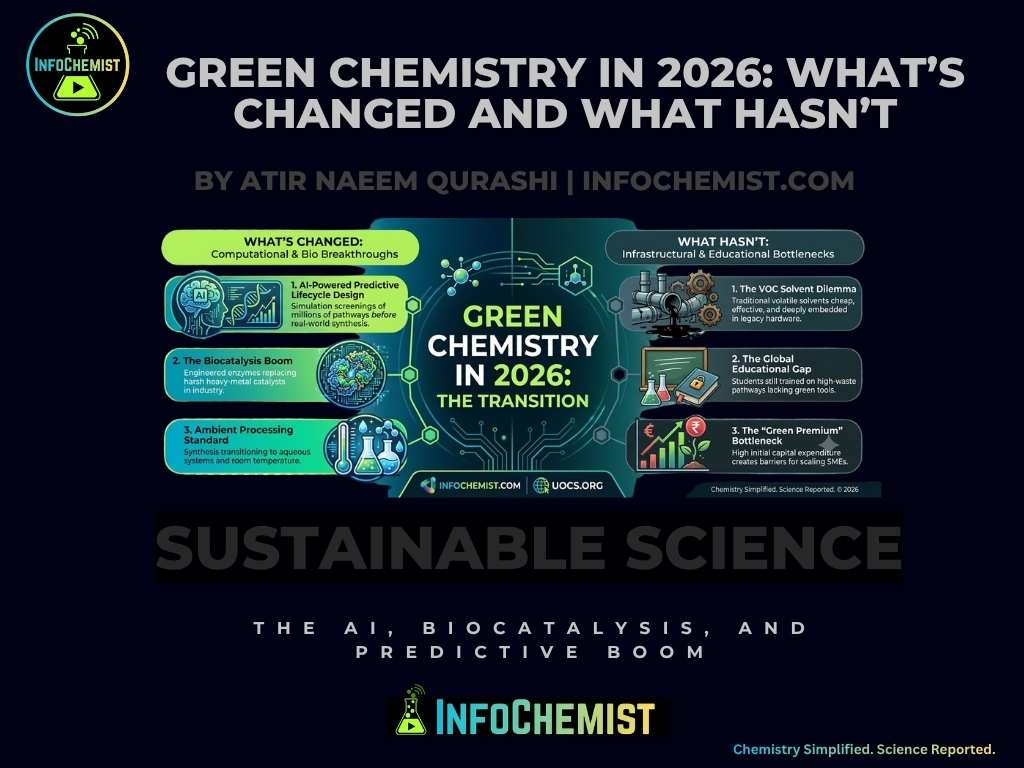
The global push toward sustainable science has officially shifted from a theoretical, corporate-social-responsibility luxury to an operational necessity. As we analyze the state of green chemistry in 2026, the Twelve Principles of Green Chemistry are no longer just alternative laboratory guidelines tucked away in the back of textbooks. They are actively rewriting industrial workflows, manufacturing economics, and academic frameworks across the globe.
Yet, as laboratory infrastructure evolves, a stark contrast emerges between rapid computational breakthroughs and heavy material bottlenecks. Here is a baseline, data-driven look at exactly where sustainable chemistry stands today—what has fundamentally changed, and what remains stubbornly gridlocked.
Technical Milestones Shifting Green Chemistry in 2026
The most significant shift over the last few years has occurred at the intersection of data science, structural biology, and molecular engineering. Generative AI tools and predictive language models have radically minimized waste before a single chemical reagent is even touched.
1. Predictive Lifecycle Design and Digital Twin Screening
Historically, discovering a viable synthetic pathway required months of trial-and-error, generating liters of toxic solvent waste for every gram of successful product. Today, machine learning algorithms act as digital twin environments. Researchers can now simulate millions of reaction pathways simultaneously, screening for atmospheric toxicity, energy consumption, and structural atom economy before initiating real-world synthesis.
By predicting precise reaction conditions, optimal catalysts, and potential side-reactions entirely in silico, these models have driven down literal benchtop chemical waste by an estimated 40% in cutting-edge research laboratories. This shift effectively transitions the traditional “fail-fast” chemical methodology from the physical fume hood to the cloud.
2. The Biocatalysis Revolution
Industrial manufacturing has accelerated its migration away from traditional, heavy-metal catalysts (such as palladium, platinum, and rhodium). These legacy catalysts require energy-intensive purification steps and generate massive, metal-contaminated aqueous waste streams that are highly hazardous to process. Instead, 2026 has become the era of engineered enzymes.
Thanks to advanced directed evolution algorithms and AI-driven structural predictions, synthetic biochemists can now design highly stable, highly specific enzymes capable of executing complex organic transformations. These bio-catalysts operate efficiently under mild ambient conditions, showcase near-perfect stereoselectivity, and eliminate the toxic heavy-metal footprint from the chemical lifecycle entirely.
3. Ambient Processing as an Industrial Standard
High-temperature, high-pressure setups—such as those operating above  and dozens of atmospheric bars—have long been the energy-draining workhorses of chemical manufacturing. Driven by rising energy costs, carbon taxes, and strict industrial emission caps, a mounting percentage of fine chemical and active pharmaceutical ingredient (API) processes have transitioned to aqueous solvent systems operating at or near room temperature. What was once a niche academic pursuit is now a validated, scalable engineering methodology used for large-scale production, saving megawatt-hours of facility power annually.
What Hasn’t: The Infrastructure, Solvent, and Cost Bottlenecks
While the computational and biological fronts are moving at breakneck speed, the physical, macroscopic realities of global supply chains and legacy infrastructures present a massive drag factor.
1. The Volatile Organic Solvent Dilemma
Solvents still account for the vast majority (frequently over 80%) of the chemical industry’s total lifecycle waste mass. While green solvents like supercritical carbon dioxide ( ), ionic liquids, and bio-derived options (like ethyl lactate and gamma-valerolactone) are widely praised in research papers, their real-world adoption remains sluggish.
Traditional volatile organic solvents (VOCs) like dichloromethane (DCM), dimethylformamide (DMF), and toluene remain incredibly cheap, highly effective, and deeply embedded in legacy manufacturing hardware. Upgrading a multinational manufacturing plant to handle alternative solvent properties (like different boiling points, viscosities, or corrosive profiles) requires millions in capital expenditure—a hurdle many scaling operations cannot yet justify.
2. The Global Educational Gap
Perhaps the most critical bottleneck isn’t found in the chemical plant, but in the classroom. While industrial leaders demand incoming professionals trained in atom economy, life-cycle analysis (LCA), and sustainable design, the vast majority of university and secondary-school chemistry curricula worldwide remain firmly anchored in the 20th century.
Emerging scientists, particularly in the developing world, are still taught chemical synthesis via legacy, high-waste pathways because their institutions lack the funds for modern equipment. Without open-access toolkits, accessible safety frameworks, and targeted educator training, the next generation of chemists will enter the workforce fundamentally unequipped to run sustainable labs.
3. The “Green Premium” in Scaling
While a sustainable pathway is vastly cheaper in terms of long-term environmental remediation and cleanup, the immediate financial reality is brutal. The initial setup cost—re-engineering batch reactors into continuous flow systems, sourcing certified bio-based raw materials, and running regulatory validation steps for alternative synthesis—creates a massive financial barrier known as the “green premium.” For small-to-medium enterprises (SMEs) operating on thin margins, choosing the green option still occasionally presents an immediate threat to operational cash flow, severely slowing down the trickledown effect of green innovations from high-budget institutional megastructures to grassroots operations.
The Bottom Line: Moving From Code to the Countertop
The tools for sustainable chemistry are more sophisticated in 2026 than at any point in scientific history. The capability to model clean reactions via generative AI and execute them using biocatalysis is a reality. However, green chemistry cannot achieve true global scale if it remains locked behind the doors of well-funded Western or institutional facilities.
To truly bridge the gap, the scientific community must democratize these breakthroughs—translating complex computational models and sustainable laboratory frameworks into accessible, real-world educational resources that teachers and students anywhere can deploy.
Want to explore the deep-tech architecture driving sustainable discovery? Discover exactly how chemical language models, transformer attention networks, and molecular graph tokenization eliminate laboratory waste before touching a beaker in our comprehensive technical guides right here at Universe of Chemical Sciences (UOCS).
Explore More in Digital Chemistry
If you found this breakdown fascinating, read our latest analysis on AI in Chemistry to explore how automation, conversational AI interfaces, and machine learning models are fundamentally transforming modern laboratory safety and molecular exploration worldwide.
