
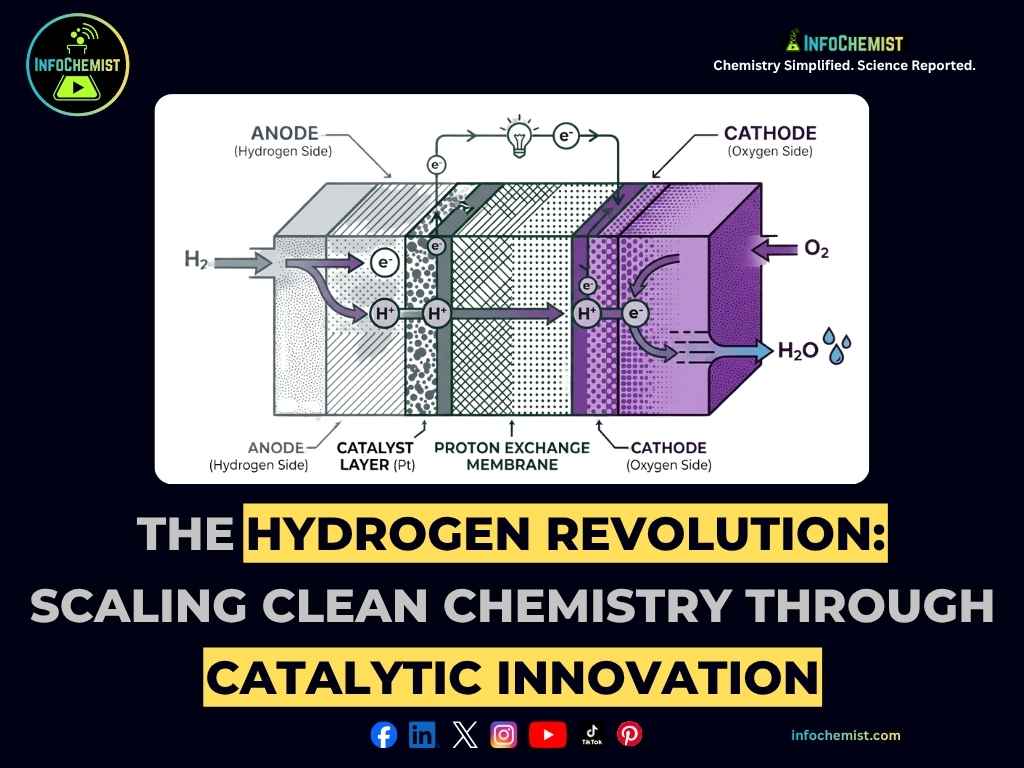
Somewhere between the urgent need to decarbonize our industrial infrastructure and the limitations of current battery technologies, a quiet energy revolution is taking hold; Hydrogen Economy. Hydrogen—the most abundant element in the universe—is shifting from an industrial feedstock used in refining and fertilizer production to the cornerstone of a global, carbon-neutral energy economy.
However, moving from a niche chemical application to a scalable, clean energy carrier requires more than just goodwill; it demands breakthroughs in the chemistry of production, storage, and conversion. The hydrogen economy is changing that equation—transforming a complex energy challenge into a manageable, sustainable solution.
What Exactly Is a Hydrogen Economy?
At its core, a hydrogen economy is a vision for an energy system where hydrogen serves as the primary medium for storing, transporting, and delivering energy. Unlike fossil fuels, which release carbon dioxide when burned, hydrogen functions as a versatile energy carrier. When consumed in a fuel cell, it reacts with oxygen to generate electricity, heat, and nothing but water vapor as a byproduct.
It is the ultimate “secondary” energy source: we produce it using electricity or heat from primary sources—like wind, solar, or nuclear—and use it whenever and wherever that energy is needed, effectively bypassing the intermittency issues of renewables.
⚡ Fast Facts
What it is: A vision for an energy system utilizing hydrogen as a primary carbon-free energy carrier.
How it works: Produced via electrolysis (splitting water) or reforming; converted back into electricity via fuel cells.
Why it matters: Enables long-term, large-scale energy storage and decarbonizes hard-to-abate sectors like heavy transport and steel manufacturing.
Key Challenge: Reducing the cost of “green” hydrogen production and expanding storage/distribution infrastructure.
Net result: Water vapor and heat are the only emissions, offering a path to true sustainability.
The Science Behind the Hydrogen Transition
The shift toward a hydrogen economy is fundamentally a chemical challenge. Currently, most hydrogen is produced via steam methane reforming, a process that relies on fossil fuels and releases significant CO2. To achieve a true “Hydrogen Revolution,” we must pivot to Electrolysis—a process akin to a fuel cell operating in reverse.
By passing electricity through water (H2O), we split it into hydrogen (H2) and oxygen (O2). When this electricity is sourced from wind or solar, the resulting product is known as Green Hydrogen. The catalysis involved—specifically the development of low-cost, high-efficiency electrocatalysts to lower the energy barrier for this splitting process—is the true engine of this innovation.
The Role of Catalytic Innovation
Raw chemical reactions are often sluggish or inefficient. Selectivity and speed—the ability to produce hydrogen at high rates with minimal energy loss—require strategic material engineering.
This is achieved through advanced catalyst design:
Non-noble metal catalysts: Replacing expensive platinum with earth-abundant materials like nickel or iron-based alloys to drive down costs.
Nanostructuring: Increasing the surface area of catalysts to accelerate gas evolution.
Surface functionalization: Coating electrodes to prevent degradation in harsh electrolytic environments, ensuring longevity and performance.
Why the Hydrogen Economy Matters
The transition to a hydrogen-fueled future is one of the most critical environmental imperatives of our time. A global reliance on coal, oil, and natural gas continues to drive atmospheric carbon concentrations to record highs. Hard-to-electrify sectors—such as long-haul trucking, shipping, aviation, and heavy industry (like iron and steel production)—have historically lacked viable low-carbon alternatives.
Conventional battery technologies are often too heavy or energy-dense limited for these applications. Hydrogen bridges this gap, delivering high energy density and fast refueling times that mirror our existing fossil-fuel infrastructure, but with zero point-of-use emissions.
Real-World Applications
Heavy Industry & Manufacturing: Providing the high-temperature heat required for steel and cement production, processes that are currently reliant on fossil fuels.
Long-Haul Transportation: Powering trucks, trains, and ships where battery weight would be prohibitive.
Grid Storage: Acting as a seasonal storage buffer; when wind or solar production exceeds demand, the surplus is used to generate hydrogen, which can then be converted back to electricity months later when demand peaks.
The Limitations
Scientific honesty requires acknowledging where current hydrogen technology still faces hurdles:
Energy Efficiency: The “round-trip” efficiency (electricity → hydrogen → electricity) is lower than direct battery usage, requiring significant technological optimization.
Infrastructure: Building a network of pipelines, storage tanks, and refueling stations is a massive capital undertaking.
Production Costs: Green hydrogen is currently more expensive than fossil-derived hydrogen; achieving a price point that competes with conventional fuels is the industry’s primary focus.
The Bottom Line
The hydrogen economy represents one of chemistry’s most powerful ideas: using molecular bonds to store and transport the clean energy of our future. By translating renewable energy into chemical form—hydrogen—we create a flexible, stable, and truly sustainable energy architecture. For the goal of a net-zero world, hydrogen is not just a scientific curiosity; it is a vital, practical tool for environmental progress.
Want to go deeper into the synthesis, characterization, and analytical performance of green energy materials — including electrochemical spectroscopy data, surface analysis, and catalytic characterization? Read our comprehensive technical breakdown at Universe of Chemical Sciences (UOCS).
Explore More at InfoChemist
Interested in how AI is accelerating the design of next-generation sensing materials? Read our analysis on AI in Chemistry to see how machine learning is transforming analytical chemistry from the molecular level up.
