
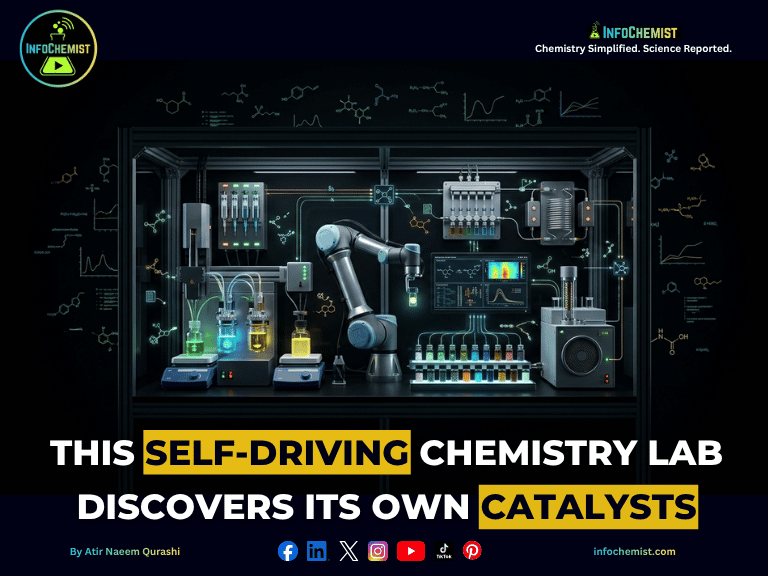
Somewhere in a laboratory at North Carolina State University, a chemistry experiment is running that no human is watching in real time. A robotic system mixes reagents, monitors a high-pressure reaction, analyzes the product, decides what to try next, and repeats the cycle — hundreds of times, without a graduate student pipetting a single drop.
The system is called Flex-Cat, and in a study published in Nature Communications on June 23, 2026, its developers report something more interesting than speed alone: catalysts that can be reprogrammed on demand to produce different chemical products, simply by changing reaction conditions.
⚡ Fast Facts
- Institution: North Carolina State University, Department of Chemical and Biomolecular Engineering
- Lead researcher: Professor Milad Abolhasani
- System: Flex-Cat — combines robotics, high-pressure flow reactors, automated analysis, and AI
- Scale of the study: 680 autonomous experiments across 16 phosphorus-based ligands
- Key result: Over 2.5-fold improvement in turnover frequency; discovery of “flexible ligands” with condition-programmable selectivity
- Published: Nature Communications, June 23, 2026
The Old Way Was Slow and Depended on Guesswork
Catalysts are the quiet workhorses of the chemical industry — substances that speed up reactions and determine which product forms, used in the manufacture of pharmaceuticals, plastics, fuels, and specialty chemicals. Finding a good one has traditionally meant a chemist proposing a candidate based on experience and chemical intuition, running the reaction by hand, analyzing the result, and adjusting — a cycle that can take days per attempt and years per project.
Abolhasani, an ALCOA Professor and University Faculty Scholar at NC State, describes the core limitation bluntly: conventional catalyst discovery is slow, expensive, and heavily dependent on human intuition. Flex-Cat was built to remove that bottleneck by turning the discovery process into what Abolhasani calls an autonomous learning cycle — the system makes a decision, runs the experiment, learns from the outcome, and then chooses the next best experiment.
What Flex-Cat Actually Does
The Flex-Cat platform integrates several pieces of hardware that normally sit in separate parts of a lab. Robotics prepare and handle reaction mixtures. High-pressure chemical reactors run the actual reactions under industrially relevant conditions. Automated product analysis identifies what came out the other end. An artificial intelligence layer takes that result and decides, without human input, what the next experimental condition should be.
Over the course of the study, the system performed 680 experiments using 16 chemically diverse phosphorus-based ligands — molecules that tune the behavior of the rhodium catalyst at the center of the reaction under investigation. The researchers ran three separate autonomous optimization campaigns, each targeting a different outcome: one aimed to maximize a branched reaction product, one aimed to maximize a linear product, and a third explored how far the system’s selectivity could be pushed in either direction.
Catalysts That Change Their Mind
The most striking result was not simply that Flex-Cat found good catalysts faster than a human team could. It is that the system identified ligands exhibiting what the researchers term condition-programmable selectivity inversion — catalysts whose product output can be switched by adjusting reaction conditions alone, without swapping out the catalyst itself.
Picture a factory machine that could be told, through a dial rather than a retooling, to switch from producing one shape of part to another. That is roughly the chemical equivalent of what these flexible ligands allow — one catalyst system, multiple possible products, selected by turning a knob on temperature or pressure rather than starting from scratch with new chemistry.
Across its three campaigns, Flex-Cat achieved over a 2.5-fold improvement in turnover frequency — a standard measure of how many reaction cycles a catalyst can drive per unit time — and expanded the accessible regioselectivity range beyond what earlier manual approaches had mapped. To confirm the results held up outside the discovery-scale experiments, the researchers translated the top candidates into a 20 milliliter reactor format, ten times the original reaction volume, and validated that the performance carried over.
Why This Matters Beyond the Lab Bench
Catalyst discovery sits upstream of an enormous share of the chemical industry. A faster, more systematic way to find and tune catalysts has implications that ripple outward:
Pharmaceutical manufacturing. Many drug synthesis routes hinge on a single well-chosen catalyst. Faster catalyst discovery can shorten the path from a promising drug candidate to a scalable manufacturing process.
Sustainable chemical production. Catalysts that can be tuned toward more atom-economical, lower-waste pathways using reaction conditions alone — rather than requiring an entirely new catalyst — align directly with green chemistry’s goal of reducing unnecessary derivatization and byproduct formation.
Industrial flexibility. A single catalyst platform capable of producing multiple products on demand could reduce the need for dedicated production lines for each chemical variant, a meaningful efficiency gain for specialty chemical manufacturers.
Research throughput. Academic labs without access to large automated infrastructure stand to benefit indirectly, as data-driven structure-performance trends extracted from autonomously generated datasets become shared knowledge for the broader catalysis community.
An Autonomous Learning Cycle, Not an Autonomous Replacement
It is worth being precise about what Flex-Cat does and does not do. The system does not decide what chemistry to pursue — that strategic direction still comes from the research team. What it automates is the exhausting, repetitive middle stage of discovery: proposing a condition, running it, reading the result, and deciding the next move, at a pace and volume no human team could sustain by hand.
That distinction matters. Flex-Cat is not a chemist. It is a very fast, very consistent experimental assistant that never gets tired of running the six-hundred-and-eighty-first trial.
The Bigger Trend
Flex-Cat belongs to a rapidly growing category of self-driving laboratories, autonomous platforms capable of designing, executing, and analyzing experiments with minimal human input, appearing across chemistry and materials science over the past several years. What distinguishes this work is its focus on catalysis specifically, and its demonstration that autonomy can uncover not just good catalysts, but catalysts with previously unrecognized flexible behavior — a property that would have been extraordinarily difficult to find through manual experimentation alone, simply because no one would have thought to test hundreds of ligands across dozens of condition combinations by hand.
The hidden engines of the chemical industry, as Abolhasani calls catalysts, just got a faster way to be discovered — and, it turns out, a faster way to be reinvented from the inside.
Curious how autonomous laboratory architecture actually works — the AI decision loop, the flow chemistry hardware, and how Flex-Cat’s dataset compares to earlier self-driving lab platforms?
Read our full technical breakdown at uocs.org.
Explore More at InfoChemist
Interested in how AI is accelerating the design of next-generation sensing materials? Read our analysis on AI in Chemistry to see how machine learning is transforming analytical chemistry from the molecular level up.
