
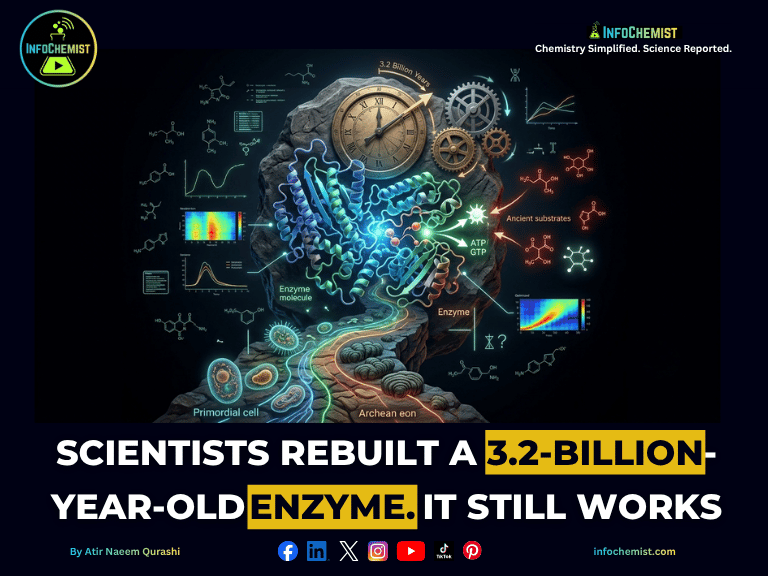
Every living thing on Earth depends, directly or indirectly, on a single enzyme’s ability to grab nitrogen from the air and make it usable for life. That enzyme, nitrogenase, has been doing this job for billions of years. Researchers at the University of Wisconsin-Madison and Utah State University have now done something remarkable: they rebuilt ancestral versions of nitrogenase as they may have existed 3.2 billion years ago, inserted the reconstructed genes into living bacteria, and watched the ancient chemistry run again.
Published in Nature Communications on January 22, 2026, the study does more than resurrect old biology. It validates one of the few chemical tools scientists have for reading Earth’s earliest biological history — and, potentially, for recognizing life on other worlds.
⚡ Fast Facts
- Institutions: University of Wisconsin-Madison and Utah State University, part of NASA’s Metal Utilization and Selection across Eons (MUSE) project
- Lead researchers: Betül Kaçar, Holly Rucker, Lance Seefeldt, Derek Harris
- Method: Ancestral sequence reconstruction — synthetic biology to reverse-engineer ancient enzyme genes and insert them into living microbes
- Time span reconstructed: Over 2 billion years of nitrogenase evolution
- Key finding: Nitrogen isotope fractionation signatures remained consistent across all reconstructed ancestral enzymes
- Published: Nature Communications, January 22, 2026
The Enzyme That Feeds the Planet
Nitrogen makes up nearly 80 percent of Earth’s atmosphere, yet most organisms cannot use it in that gaseous form. Converting atmospheric nitrogen gas into a biologically usable form — a process called nitrogen fixation — is carried out by a single enzyme: nitrogenase. Nearly every nitrogen atom in every protein, in every living cell on the planet, passed through a nitrogenase enzyme at some point in its history.
Because this single-enzyme bottleneck controls such a fundamental biochemical process, scientists have long wondered whether its evolutionary history could be read directly from the geological record. When nitrogenase fixes nitrogen, it leaves a subtle chemical fingerprint — a specific ratio of nitrogen isotopes — in the biomass of the organism using it. That fingerprint, in theory, should be preserved in ancient sedimentary rocks, offering a window into when and how nitrogen fixation began. The problem was that no one knew whether ancient nitrogenases, which differ substantially in their genetic sequence and protein structure from modern versions, would leave the same isotopic signature.
Bringing a 3.2-Billion-Year-Old Gene Back to Life
To answer that question directly, the research team used a technique called ancestral sequence reconstruction. By comparing the genetic sequences of nitrogenase across a wide range of modern organisms, and mapping how those sequences likely diverged from one another over evolutionary time, the researchers statistically inferred what the ancestral gene sequences probably looked like at various points across roughly two billion years of history.
They then synthesized those inferred ancient genes in the laboratory and inserted them into a living host bacterium, Azotobacter vinelandii, replacing its modern nitrogenase genes entirely. The engineered bacteria had no other source of usable nitrogen — every nitrogen atom in their bodies had to come from the resurrected ancestral enzyme working correctly.
It is a bit like reconstructing an extinct language from fragments of its descendant dialects, then finding a living person willing to actually speak it — and discovering that the grammar still works well enough for real conversation.
The Chemistry Held Steady for Two Billion Years
Under controlled laboratory conditions, the team measured nitrogen isotope fractionation in the cell biomass of bacteria running on each reconstructed ancestral enzyme, comparing the results against modern nitrogenase and against the isotopic evidence found in Earth’s oldest sedimentary rocks.
The result was striking in its consistency. As Holly Rucker, the study’s lead author, described it: as you step back in time, the DNA sequences of these ancient nitrogenases are very different from modern nitrogenases, and the enzyme structure varies with age — yet despite these sequence and structure-level differences, the ancient enzymes still do the same chemistry as their modern descendants. The isotopic signatures held steady across the full two-billion-year span the team examined.
That consistency matters enormously for anyone trying to read Earth’s early biological history from rock chemistry alone. It confirms that the nitrogen isotope signatures found in ancient sediments genuinely do reflect biological nitrogen fixation, rather than some other geochemical process that happens to produce a similar signal.
Why This Matters Beyond a Single Enzyme
Reading Earth’s earliest biosphere. With this validation in hand, geochemists can now interpret nitrogen isotope patterns in Archean-era rocks with substantially more confidence, extending our understanding of when biological nitrogen fixation — and by extension, complex microbial life — first became widespread on Earth.
The search for life beyond Earth. Robotic missions to Mars and other worlds rely on chemical biosignatures to search for evidence of past life. A validated, evolutionarily stable biosignature tied to a single well-understood enzyme gives astrobiologists a more reliable target to search for in extraterrestrial samples.
Understanding metabolic resilience. The finding that a two-billion-year-old enzyme lineage preserved its core chemical function despite extensive sequence divergence offers insight into which biochemical processes are evolutionarily “locked in” versus flexible — knowledge relevant to fields ranging from synthetic biology to the future engineering of more efficient nitrogen-fixing crops.
A template for future work. The rebuilt enzyme work links laboratory biology directly to rock data, and the same ancestral reconstruction approach can now be extended to other enzymes central to Earth’s biogeochemical cycles, offering additional independent lines of evidence for the timeline of early life.
A Living Fossil, Engineered Rather Than Excavated
There is something quietly remarkable about the method itself. No amber-trapped microbe, no million-year-old ice core was required to access three-billion-year-old biochemistry. The genetic information survived, distributed and disguised across billions of years of descendants, waiting to be statistically reconstructed and given a living host willing to run the ancient program.
The nitrogenases that once fixed nitrogen for Earth’s earliest microbial ecosystems are, in a very real sense, running again — inside a laboratory strain of bacteria, feeding on the same atmospheric nitrogen their ancestors once did.
Interested in the molecular biology of ancestral sequence reconstruction, the chemistry of nitrogen isotope fractionation, and how this connects to the search for life on Mars?
Read our complete technical deep-dive at uocs.org.
Explore More at InfoChemist
Interested in how AI is accelerating the design of next-generation sensing materials? Read our analysis on AI in Chemistry to see how machine learning is transforming analytical chemistry from the molecular level up.
