
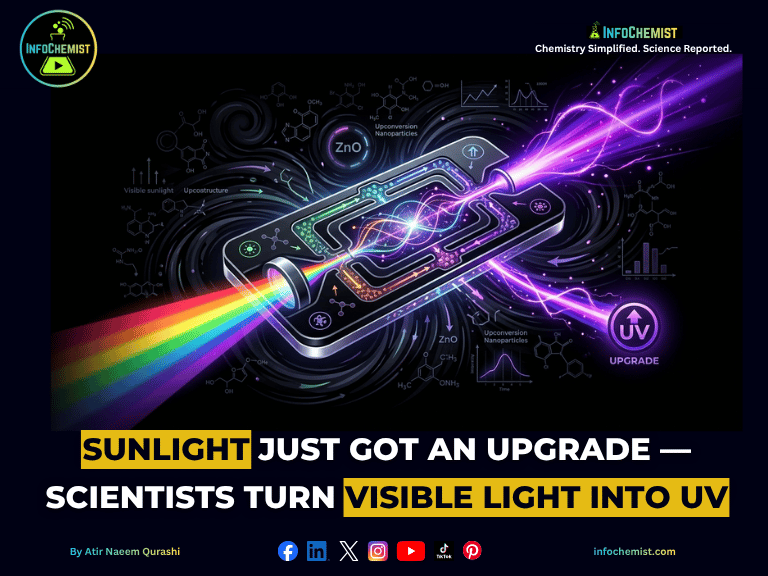
Every second, the sun delivers an almost incomprehensible amount of energy to Earth. Yet most of what reaches us — visible light — carries too little energy per photon to power some of chemistry’s most useful reactions. The high-energy ultraviolet light that drives photocatalysis, air purification, and industrial curing makes up only a sliver of the solar spectrum.
A team at Kyushu University’s Research Center for Negative Emissions Technologies has spent over a decade chasing a way around this limitation. Their answer, published in Nature Communications on June 23, 2026, is a solid material that takes ordinary sunlight and upgrades part of it into ultraviolet light — using nothing but molecular engineering.
⚡ Fast Facts
- Institution: Kyushu University, Research Center for Negative Emissions Technologies, Japan
- Core molecule: Dihydroindenoindenedene (DHI), an alkyl-modified organic semiconductor
- Mechanism: Triplet-triplet annihilation photon upconversion
- Performance: 1.9% visible-to-UV conversion efficiency under natural sunlight; solid-state fluorescence quantum yield exceeding 60%; stable for over 100 hours in air
- Published: Nature Communications, June 23, 2026
- Why it matters: The first air-stable solid system to achieve meaningful upconversion under ordinary outdoor sunlight, without lasers or sealed environments
Two Photons In, One Stronger Photon Out
The process at the heart of this work is called photon upconversion. In simple terms, two lower-energy photons of visible light combine to produce a single higher-energy photon of ultraviolet light. Chemists have understood this concept for decades. Making it work efficiently outside a laboratory, in a solid material, under ordinary daylight, is where nearly every previous attempt has failed.
The mechanism responsible is triplet-triplet annihilation. A donor molecule absorbs a photon of visible light and enters an excited state known as a triplet. That excited energy migrates to a neighboring acceptor molecule. When two of these excited triplet states meet and collide, they annihilate each other, releasing their combined energy as a single photon of ultraviolet light. It is a form of molecular teamwork — two modest contributions merging into one powerful output.
The obstacle has always been getting solid materials to sustain this handoff of energy efficiently. Pack the molecules too close together and unwanted side reactions consume the energy before it can be released as useful UV light. Space them too far apart and the energy transfer between donor and acceptor molecules becomes too slow to matter.
Engineering the Gap Between Molecules
The Kyushu team’s solution centers on a molecule called dihydroindenoindenedene, or DHI. By attaching alkyl chains — simple carbon-hydrogen branches — to specific carbon atoms in the DHI structure, the researchers were able to precisely control how closely neighboring DHI molecules could pack together in the solid state.
This is not unlike arranging seating at a long dinner table. Guests seated too close cannot pass dishes without spilling them. Guests seated too far apart cannot pass anything at all. The right spacing lets everyone hand things along smoothly. The alkyl chains attached to DHI’s rigid, four-bonded sp³ carbon atoms function as that spacing mechanism — holding neighboring molecules at the precise distance needed for efficient triplet energy transfer, without the energy-wasting side reactions that plague more tightly packed systems.
The result: a solid-state film with a fluorescence quantum yield exceeding 60 percent, and when paired with a donor molecule sensitive to visible light, an overall visible-to-UV conversion efficiency of 1.9 percent under real sunlight conditions.
Why 1.9 Percent Is a Bigger Deal Than It Sounds
On its own, 1.9 percent might not sound like a headline number. But context matters. Earlier upconversion systems generally required liquid, oxygen-free solutions sealed away from air — fragile, laboratory-bound setups that degraded within hours of exposure to real-world conditions. The Kyushu material, by contrast, held its performance for more than 100 hours of continuous exposure to air.
To confirm the material could do real chemical work and not just register on a spectrometer, the researchers exposed their film to simulated sunlight containing only visible wavelengths — no artificial UV input at all. The ultraviolet light generated by the film was strong enough to cure and solidify a UV-sensitive resin, a task that would ordinarily demand a dedicated UV lamp.
That is the difference between a laboratory curiosity and a working platform technology.
Where This Could Matter
Photocatalysis and purification. Many air- and water-purification technologies rely on UV-activated catalysts such as titanium dioxide. A durable, sunlight-powered UV source could allow these systems to operate anywhere sunlight reaches, with no electrical UV lamp required.
Industrial UV curing. Coatings, adhesives, inks, and 3D-printed resins are widely cured using UV lamps that consume significant electricity. A passive, solar-driven upconversion layer built into manufacturing lines could reduce that energy demand considerably.
Solar-driven synthesis. Photochemists routinely rely on UV light to drive reactions that are otherwise inaccessible using visible light alone. A material like this expands the practical toolkit for solar-powered chemical synthesis — turning ordinary sunlight into a genuine UV light source for the bench.
Manufacturing cost. According to the research team, the material is built from relatively inexpensive starting compounds and can be manufactured through straightforward chemical routes, an important factor for eventual commercial scale-up. A patent has already been filed.
Fourteen Years, Eleven Days
The project traces back to 2012, when Professor Nobuo Kimizuka began investigating photon upconversion through molecular self-assembly. Progress came in increments across the following decade, through solution-based and gel-based systems that hinted at what might be possible in a fully solid material.
The decisive breakthrough arrived in May 2024, less than a year before Kimizuka’s retirement — setting off what the research team has described as an intense final push to bring the work to publication. The completed manuscript reached Kimizuka just eleven days before he left the laboratory for the final time.
Fourteen years of incremental molecular engineering, condensed into a result that could quietly reshape how UV-dependent chemistry gets powered.
The Bigger Picture
What makes this result significant is not the 1.9 percent figure itself, but what it represents: a solid, air-stable, inexpensive material that performs real photochemical work using nothing but ordinary sunlight. Efficiency figures in materials chemistry tend to climb quickly once a stable, working platform exists — today’s proof of concept often becomes tomorrow’s commercial product. If that trajectory holds here, industries that have depended on electrically powered UV lamps for decades may soon have sunlight as a genuine, cost-free alternative.
Want a deeper technical look at the molecular architecture behind triplet-triplet annihilation, the role of sp³ carbon spacing, and how this compares to earlier upconversion systems?
Read our full technical breakdown at uocs.org.
Explore More at InfoChemist
Interested in how AI is accelerating the design of next-generation sensing materials? Read our analysis on AI in Chemistry to see how machine learning is transforming analytical chemistry from the molecular level up.
