
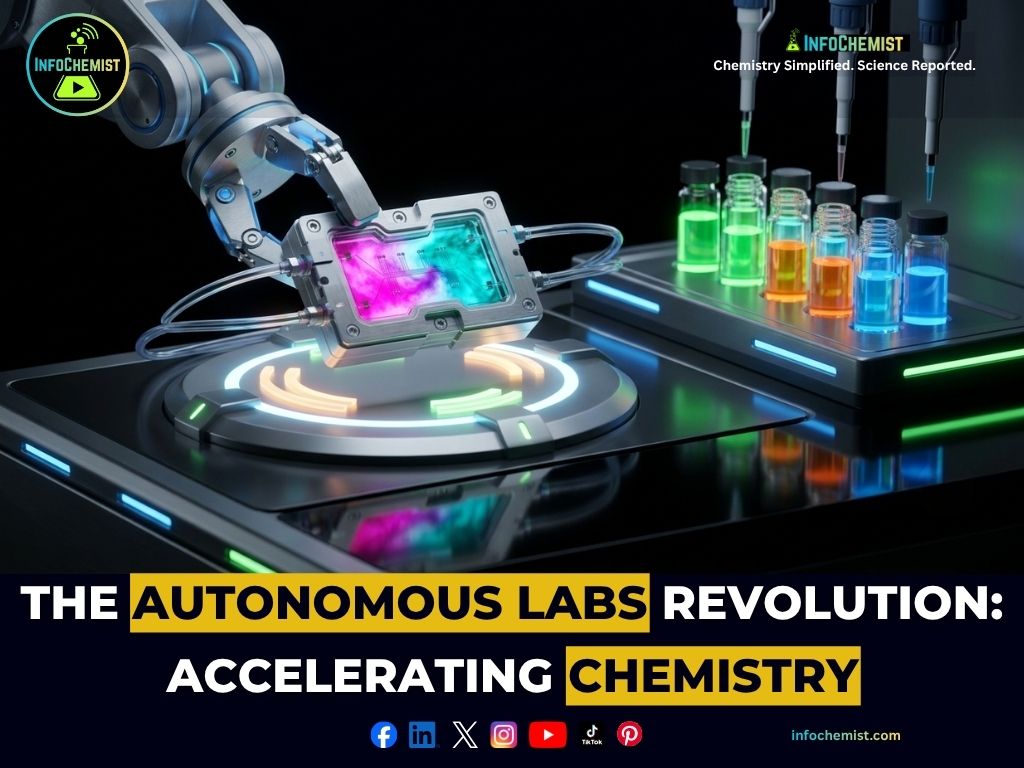
Accelerate Discovery with Autonomous Labs: The era of the solitary chemist hunched over a beaker for months on end is fading as a new, robotic dawn rises in the research world. Recent breakthroughs at institutions like the University of Toronto and Georgia Institute of Technology prove that machines can now design, execute, and analyze experiments faster than any human team, fundamentally rewriting the rules of scientific innovation.
⚡ Fast Facts
What they are: Autonomous labs utilize integrated robotics and artificial intelligence to perform end-to-end scientific research without constant human guidance.
How they work: Closed-loop systems analyze experimental results in real-time, using machine learning to adjust variables and formulate new hypotheses for the next trial.
Why they matter: These systems slash R&D timelines from months to days, allowing researchers to explore massive chemical spaces previously considered inaccessible.
Where they operate: Leading academic and industrial hubs in North America and Europe now deploy these platforms to accelerate material and pharmaceutical discovery.
The Result: Scientists transition from manual labor to high-level strategic oversight, focusing on complex problem-solving rather than repetitive bench tasks.
Breaking the R&D Bottleneck
For generations, chemical research functioned as a linear, human-paced crawl. Scientists identified a hypothesis, manually prepared samples, ran tests, and waited hours or days for results before repeating the cycle. This traditional “trial-and-error” approach limits the number of variables one can test, essentially keeping the discovery of novel materials trapped behind the speed of human physical capacity.
Think of it like trying to find a single grain of sand in a desert using only a small hand-held shovel. Even the most dedicated researcher eventually hits a physical wall, limiting how many chemical combinations they can effectively explore. By contrast, current chemical space is vast, spanning millions of potential molecular candidates that remain untouched simply because manual testing is too slow.
How Autonomous Labs Work
At the core of these self-driving systems lies the concept of a Closed-Loop Experimentation cycle. This architecture connects robotic hardware with advanced Machine Learning (ML) algorithms that continuously update their knowledge base based on incoming data. The AI does not just follow a rigid set of instructions; it actively learns from the success or failure of the last trial.
Systems like the “Ada” platform at the University of Toronto demonstrate this capability by autonomously scouting for new materials. The robot moves vials, manages heating cycles, and analyzes output using integrated sensors to determine if the result matches the desired properties. If the material falls short, the ML model identifies which chemical variables to tweak and triggers the robot to start a refined version of the experiment immediately.
Can these systems actually innovate independently?
These platforms innovate by identifying correlations and patterns across thousands of data points that remain invisible to the human eye. By automating the data collection process, they provide a continuous stream of high-quality, reproducible information. This consistency ensures that the AI develops a precise understanding of the chemical landscape, eventually making decisions that minimize wasted resources and maximize breakthrough potential.
Real-World Impact
The integration of these systems is currently reshaping the pharmaceutical industry in the United States and Canada. Companies now utilize automated platforms to iterate through thousands of molecular candidates for drug discovery in record time. This rapid scanning minimizes the time required to move from an initial lead compound to a viable candidate for clinical testing.
In Europe and Australia, researchers are applying the same principles to advance Green Chemistry and materials science. For example, autonomous setups identify optimal conditions for recycling complex plastics into clean fuels, focusing on minimizing energy consumption throughout the reaction. Researchers also use these labs to discover high-performance electrolytes for next-generation Lithium-Ion Batteries, tailoring atomic structures to improve charging speed and thermal stability.
The Challenges Ahead
Despite their potential, these high-tech setups face significant hurdles regarding accessibility and initial capital investment. Smaller academic laboratories often struggle to afford the specialized robotics and the expert software engineering support required to maintain such complex systems. Many researchers also voice concerns regarding data security, as the reliance on cloud-connected AI systems raises questions about the protection of intellectual property during the testing of novel chemical formulas.
Furthermore, a significant skills gap exists in the modern chemistry workforce regarding the operation of autonomous infrastructure. Operating these labs requires a hybrid scientist who understands both advanced chemical synthesis and the complexities of robotic software maintenance. Bridging this gap demands a shift in educational curricula to ensure the next generation of chemists is as comfortable with programming an algorithm as they are with performing a titration.
The Path Forward
The rise of autonomous labs represents a shift toward a more efficient, high-velocity future for global science. By delegating the repetitive, physically taxing aspects of experimental science to smart robotics, we clear the path for deeper human intellectual inquiry. We are not replacing the scientist; we are giving them the ultimate tool to unlock the secrets of the molecular world.
Want to explore the complex integration of AI agents and physical synthesis in autonomous labs?
Read our comprehensive deep-dive at uocs.org.
Explore More at InfoChemist
Interested in how AI is accelerating the design of next-generation sensing materials? Read our analysis on AI in Chemistry to see how machine learning is transforming analytical chemistry from the molecular level up.
