
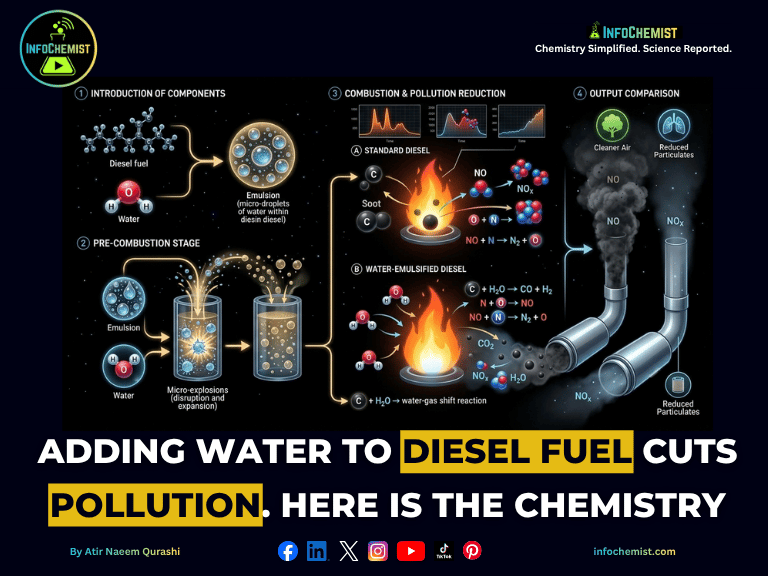
Water and fuel are supposed to be enemies. Every driver has heard the warning about water contamination ruining an engine. Yet a growing body of combustion chemistry research is showing that deliberately blending small amounts of water into diesel fuel, under carefully controlled conditions, can cut two of diesel engines’ most harmful pollutants by well over half — without modifying the engine itself.
A comprehensive review published in Carbon Research examined the accumulated evidence behind this approach, known as water-in-diesel emulsion, or WiDE, and the numbers are hard to ignore: reductions of up to 67 percent in nitrogen oxide emissions and 68 percent in particulate matter, positioning it as a genuinely practical bridge technology for cleaner combustion.
⚡ Fast Facts
- What it is: A stable emulsion of microscopic water droplets dispersed throughout diesel fuel, held together with surfactants
- Best-case results: Up to 67% reduction in NOx emissions; up to 68% reduction in particulate matter
- Additional benefit: Improved brake thermal efficiency in several formulations
- Stability achieved: Emulsions stable for up to 60 days with proper surfactant formulation
- Key advantage: Requires no engine modification — compatible with existing diesel infrastructure
Why Diesel Engines Pollute the Way They Do
Diesel engines are prized for their efficiency, durability, and torque, which is why they dominate heavy transport, agriculture, and industrial power generation. That same combustion process, however, produces nitrogen oxides, particulate matter, carbon monoxide, hydrocarbons, and sulfur dioxide — pollutants linked to respiratory disease, cardiovascular problems, and smog formation.
Nitrogen oxide formation in particular is driven largely by combustion temperature. Diesel engines burn fuel at very high peak flame temperatures, and the hotter that flame burns, the more atmospheric nitrogen gets oxidized into NOx compounds. Reduce the peak flame temperature, and NOx formation drops correspondingly.
That single relationship is the chemical key to why adding water works.
Micro-Explosions Inside a Fuel Droplet
A water-in-diesel emulsion is produced by dispersing microscopic droplets of water throughout diesel fuel, using surfactants — specialized molecules that stabilize the mixture and prevent the water and oil from separating back out, the way they normally would.
When this emulsified fuel is injected into a hot combustion chamber and ignited, something unusual happens at the droplet scale. Water has a much lower boiling point than diesel fuel, and it is trapped inside each diesel droplet. As the surrounding diesel heats up, the water inside flashes to steam almost instantly, and that sudden phase change violently ruptures the diesel droplet from the inside — a phenomenon researchers call micro-explosion.
Picture a water balloon dropped onto hot pavement, except the balloon is a droplet of fuel a fraction of a millimeter wide, and the explosion happens in microseconds. Instead of one relatively large diesel droplet burning as a single unit, the micro-explosion shatters it into a fine mist of much smaller droplets.
That finer atomization has two compounding effects. First, it dramatically increases the surface area of fuel exposed to oxygen, allowing more complete combustion and reducing unburned particulate soot. Second, the endothermic process of vaporizing the water — turning liquid water to steam requires absorbing heat — pulls the local peak flame temperature down, directly suppressing the thermal pathway that produces nitrogen oxides.
What the Data Actually Shows
The evidence collected across the reviewed studies is substantial rather than anecdotal. Introducing water at the compression stroke of a diesel engine, one study found, produced a 55.6 percent reduction in NOx emissions. Other formulations tested across a range of engine loads and water concentrations between two and ten percent by volume showed NOx reductions in the 21 to 40 percent range under typical operating conditions, with the most optimized formulations reaching the reported 67 percent maximum.
Particulate matter followed a similarly strong pattern, with reductions reaching 68 percent in the best-performing formulations — a direct consequence of the improved atomization and more complete combustion driven by the micro-explosion effect.
Notably, several studies also reported improvements in brake thermal efficiency, the standard measure of how effectively an engine converts fuel energy into usable mechanical work. That is a meaningful finding, because pollution-reduction strategies often come at the cost of engine performance or fuel economy. Here, at least in some formulations, the engines ran both cleaner and more efficiently.
There is a documented tradeoff, however. Most studies found a drop in NOx alongside a modest rise in particulate mass in certain configurations, as well as an increase in carbon monoxide and unburned hydrocarbon emissions in some test conditions — underscoring that formulation quality and operating parameters matter considerably to the outcome.
Why This Approach Is Attracting Fresh Attention
No infrastructure overhaul required. Unlike selective catalytic reduction systems or particulate filters, which require significant capital investment and are often impractical to retrofit onto older engines, water-in-diesel emulsion works with existing diesel engines largely unmodified.
A bridge technology. As industries and fleets transition toward electrification and hydrogen, WiDE offers a lower-cost interim strategy for reducing emissions from the diesel infrastructure that will remain in heavy use for years to come, particularly in agriculture, marine shipping, and remote power generation.
Formulation science is advancing. With surfactants, WiDE formulations can now achieve stable emulsion quality for up to 60 days, addressing one of the earlier practical barriers to commercial deployment — fuel that separates back into oil and water within hours is not commercially viable, and formulation chemistry has moved well past that limitation.
The Chemistry Reality Check
Water-in-diesel emulsion is not a silver bullet. Its performance depends heavily on the specific surfactant chemistry, water percentage, injection pressure, and engine operating conditions used — and the tradeoffs in carbon monoxide and hydrocarbon emissions mean it functions best as one component of a broader emissions strategy rather than a total replacement for other controls. But as a low-cost, infrastructure-compatible way to meaningfully cut two of diesel’s most harmful pollutants, the underlying combustion chemistry is sound, well-documented, and increasingly difficult to dismiss.
Want the full combustion chemistry breakdown — surfactant formulation, droplet micro-explosion physics, and a comparison of WiDE against exhaust gas recirculation and selective catalytic reduction?
Read our complete technical analysis at uocs.org.
Explore More at InfoChemist
Interested in how AI is accelerating the design of next-generation sensing materials? Read our analysis on AI in Chemistry to see how machine learning is transforming analytical chemistry from the molecular level up.
