
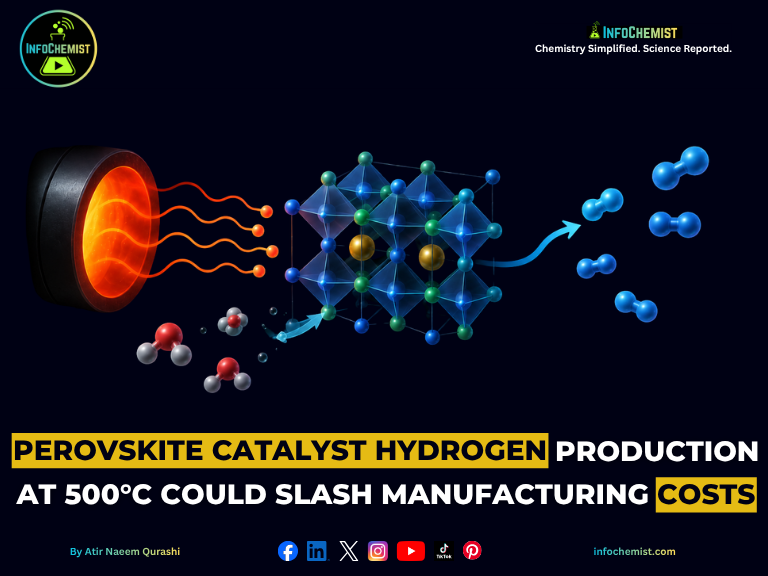
Hydrogen is often called the fuel of the future, but producing it cleanly has remained stubbornly expensive. A research team at the University of Birmingham has developed a catalyst that could change that equation directly, by lowering the operating temperature of one of hydrogen’s most scalable production methods by as much as 500 degrees Celsius.
Published in the International Journal of Hydrogen Energy, the work led by Professor Yulong Ding centers on a class of materials called perovskites — and a provisional economic analysis suggests the resulting hydrogen could actually undercut the cost of both existing green and blue hydrogen production pathways.
⚡ Fast Facts
- Institution: University of Birmingham, School of Chemical Engineering, with University of Science and Technology Beijing
- Lead researcher: Professor Yulong Ding
- Catalyst material: BNCF perovskite (barium, niobium, calcium, iron oxide)
- Temperature reduction: Water splitting now achievable at 150–500°C, versus over 1300°C conventionally — a 500°C reduction
- Regeneration: Catalyst can be regenerated at 700–1000°C and reused across at least 10 production cycles
- Published: International Journal of Hydrogen Energy, 2026
The Problem With Making Clean Hydrogen
Hydrogen is the most abundant element in the universe, and as a fuel it produces only heat and water on combustion — no carbon emissions at the point of use. That clean-burning profile is exactly why hydrogen is central to so many decarbonization strategies. The uncomfortable reality is that around 95 percent of global hydrogen production still depends on fossil fuels, primarily through methane reforming, which releases significant carbon dioxide in the process of making a fuel meant to help eliminate it.
Water splitting — separating water molecules directly into hydrogen and oxygen — avoids that fossil fuel dependency entirely. Among the available water-splitting techniques, thermochemical splitting stands out for its scalability. Its major drawback has always been temperature: conventional thermochemical water splitting typically requires heating a catalyst material above 1300 degrees Celsius, an energy-intensive threshold that has limited the method’s widespread adoption.
A Catalyst That Breathes Oxygen In and Out
The Birmingham team focused on a class of materials called perovskites, specifically a formulation combining barium, niobium, calcium, and iron — designated BNCF. Perovskites have a distinctive crystal lattice structure that allows them to absorb oxygen atoms into that structure at one temperature and release them again at another, a property that sits at the heart of thermochemical water splitting.
The basic cycle works like this: at high temperature, the perovskite releases oxygen from its crystal lattice, creating oxygen vacancies within the material. When that oxygen-depleted catalyst is then exposed to water vapor at a different temperature, the material pulls oxygen atoms out of the water molecules to refill those vacancies in its structure, releasing the water’s hydrogen atoms as hydrogen gas in the process. The catalyst can then be heated again to release the absorbed oxygen and reset for another cycle.
Think of the perovskite lattice as a sponge that can be wrung dry at one temperature and made to soak up water at another — except here, what it selectively absorbs and releases is oxygen, and what gets liberated in the exchange is hydrogen fuel.
Finding the Formulation That Works at Lower Heat
The research team tested a series of BNCF perovskite formulations, varying the iron content, to determine which variant could sustain this oxygen exchange cycle at the lowest practical temperature. A formulation designated BNCF100 emerged as the standout performer, capable of producing substantial yields of hydrogen across a temperature range of 150 to 500 degrees Celsius — roughly 500 degrees Celsius below the temperatures required by conventional thermochemical water-splitting catalysts.
Critically, the catalyst’s durability held up under repeated use. The study confirmed the material can be regenerated at 700 to 1000 degrees Celsius and retains its ability to produce hydrogen across at least 10 full production cycles, with X-ray diffraction analysis showing little sign of structural degradation in the catalyst throughout that repeated cycling.
Why 500 Degrees Matters More Than It Sounds
Temperature is not just a technical detail in thermochemical hydrogen production — it is the primary cost driver. Every degree of heat required translates directly into energy input, equipment durability demands, and infrastructure cost. Cutting the required temperature range by 500 degrees Celsius does not merely make the process modestly more efficient; it opens up entirely new sources of heat that were previously too cool to be useful.
Foundation industry sectors such as steel, cement, glass, and chemicals sectors generate enormous quantities of waste heat as a byproduct of their existing operations — heat that is often simply vented or cooled away because it falls below the threshold needed for most industrial processes. With the operating window now reduced to 150 to 500 degrees Celsius, that previously wasted industrial heat becomes a viable, essentially free energy input for hydrogen production.
That distinction matters enormously for where and how hydrogen gets made. If hydrogen production can be sited directly at or near industrial waste heat sources, it sidesteps one of clean hydrogen’s most persistent practical obstacles: the cost and complexity of storing and transporting hydrogen gas over long distances. Producing hydrogen locally, where it will also be used locally, removes that transport burden entirely.
Cheaper Than Green or Blue Hydrogen
Perhaps the most striking claim in the study is economic rather than purely chemical. A provisional cost-competitiveness analysis conducted by the research team found that hydrogen produced through this low-temperature perovskite water-splitting route could be delivered at a lower cost than both green hydrogen, produced through electrolysis powered by renewable electricity, and blue hydrogen, produced from methane reforming paired with carbon capture and storage.
That cost advantage was most pronounced in regions with low renewable energy tariffs, such as Australia — precisely the kind of location where abundant cheap renewable electricity or industrial waste heat could feed directly into a distributed hydrogen production network, rather than requiring hydrogen to be manufactured centrally and shipped elsewhere.
From Laboratory Result to Commercial Pathway
The path toward real-world deployment is already underway. University of Birmingham Enterprise has filed a patent application covering the use of BNCF catalysts for low-temperature water splitting and is now actively seeking development partners to advance the technology across the UK and Europe, with the underlying research conducted in collaboration with the University of Science and Technology Beijing.
Global hydrogen strategies have faced a difficult stretch recently, with several major projects delayed or canceled due to cost overruns, prompting real questions about whether hydrogen can compete economically with batteries, heat pumps, and direct electrification as decarbonization tools mature. A catalyst that meaningfully undercuts the temperature — and by extension the cost — of clean hydrogen production does not resolve every challenge facing the hydrogen economy. But it addresses one of the most fundamental ones directly, at the level of the chemistry itself.
Want to explore the full thermochemical cycle, the crystallography of BNCF perovskites, and how this compares to electrolysis-based green hydrogen production?
Read our complete technical breakdown at uocs.org.
Explore More at InfoChemist
Interested in how AI is accelerating the design of next-generation sensing materials? Read our analysis on AI in Chemistry to see how machine learning is transforming analytical chemistry from the molecular level up.
