
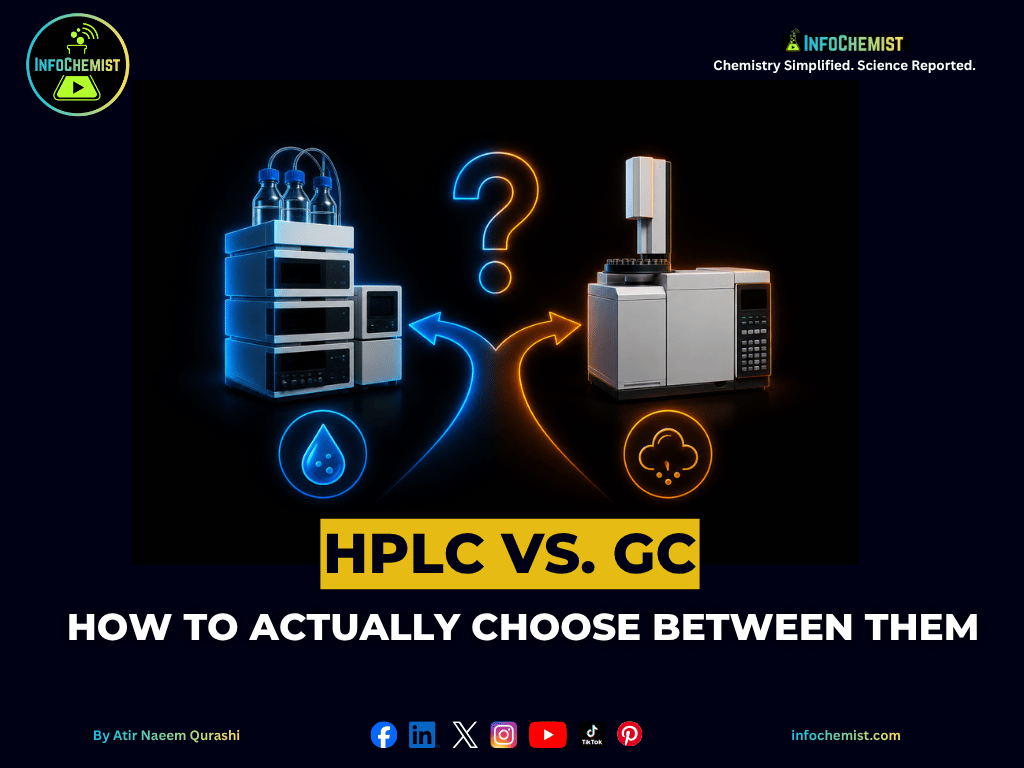
Every analytical chemist eventually hits the same fork in the road: a sample lands on the bench, and before any method development begins, someone has to decide whether it’s going on the HPLC or into the GC. Textbooks tend to present the two techniques side by side as if the choice were purely academic. In a working lab, it isn’t. Get it wrong and you’ll spend a week fighting degradation products, ghost peaks, or a column that simply refuses to resolve anything — before ever touching the actual science question you set out to answer.
Start with the molecule, not the instrument
The single most useful question to ask first is: can this compound survive being turned into a gas without falling apart? That’s the real gatekeeper. Gas chromatography (GC) separates compounds by carrying them through a column as a vapor, using an inert carrier gas — helium, nitrogen, or hydrogen — and heating the system until the analyte volatilizes. If your compound can tolerate that heat without decomposing, GC is usually the faster, cheaper, and higher-resolution option. If it can’t — because it’s thermally labile, a salt, a large biomolecule, or simply too heavy to volatilize at reasonable temperatures — high-performance liquid chromatography (HPLC) is the only realistic path.
This is why HPLC dominates in pharmaceutical quality control: active pharmaceutical ingredients, biologics, and many excipients are polar, non-volatile, or heat-sensitive, and pushing them through a GC column would simply degrade them before separation ever happened. GC, by contrast, owns the volatile-organics world — residual solvents, environmental hydrocarbons, aroma and flavor compounds, and many forensic toxicology targets.
The mechanical difference that drives everything else
The two techniques don’t just handle different molecules; they achieve separation through fundamentally different physics. In GC, the mobile phase — the carrier gas — is inert. It doesn’t interact chemically with the analyte; it just moves the sample through the column while the stationary phase coating the column walls does the actual separating based on volatility and affinity. In HPLC, the mobile phase is an active participant. Changing the solvent’s polarity, pH, or composition directly changes how well compounds separate, which is why HPLC method development often revolves around solvent gradient optimization rather than temperature programming.
That distinction cascades into everything else about the two systems. GC ovens use temperature as the primary tuning variable; ramp the oven slowly and compounds elute in order of increasing boiling point. HPLC systems use pressure and solvent chemistry as the primary variables, which is why HPLC pumps need to generate serious back-pressure to push a viscous liquid mobile phase through a tightly packed column — liquids are simply denser and more resistant to flow than gases.
Speed, sensitivity, and cost — the practical trade-offs
If raw throughput matters, GC usually wins. Gas moves through a column faster than liquid, and GC runs are frequently shorter than equivalent HPLC runs for compounds that suit the technique. GC also tends to edge out HPLC on sensitivity for volatile compounds, especially when paired with mass spectrometry (GC-MS), which is part of why GC-MS remains the gold standard for trace-level environmental and forensic screening.
Cost tells a different story, though. GC systems avoid the ongoing expense of HPLC-grade solvents and the associated chemical waste disposal that liquid chromatography generates run after run. Over the life of an instrument, that recurring solvent and waste cost is a real budget line — one that often gets underestimated when a lab is deciding which platform to invest in for a new application.
A rule of thumb for the undecided case
For heat-sensitive compounds where the volatility question is genuinely ambiguous — vitamins are the classic teaching example — the safer default is to start with HPLC. It’s the gentler technique on the analyte, and a failed HPLC run rarely destroys your sample the way an ill-advised GC injection can turn a heat-sensitive molecule into a chromatogram full of degradation artifacts. Anyone who has watched a batch of vitamin standards come apart under GC oven heat learns this lesson exactly once.
It’s also worth remembering that in most real-world laboratories, the choice isn’t actually either/or. Pharmaceutical QC labs routinely run HPLC for API and impurity quantification alongside GC for residual solvent testing on the same product, because a single finished drug substance generates analytical questions that no single chromatographic technique can answer alone. The two methods are complementary tools in the same toolbox, not competitors — and the fastest way to waste a week in the lab is to insist on making one of them do a job the molecule was never suited for in the first place.
The takeaway
Before opening any method-development software, ask three questions: Is the compound volatile and thermally stable? Is it polar or non-polar? What’s the sample matrix? The answers will point you to GC or HPLC almost every time — and save you the far more expensive lesson of finding out the hard way, mid-run, that you guessed wrong.
Want to explore more with a deeper insight? Read our complete technical breakdown at uocs.org.
Explore More at InfoChemist
Interested in how AI is accelerating the design of next-generation sensing materials? Read our analysis on AI in Chemistry to see how machine learning is transforming analytical chemistry from the molecular level up.

Excellent practical comparison of HPLC and GC. The point about starting with the molecule rather than the instrument is especially important, since volatility, thermal stability, polarity, and sample matrix can significantly influence method selection. For research materials, combining the right analytical technique with appropriate reference standards and quality documentation can also help researchers assess purity and improve reproducibility. I appreciate the emphasis on treating HPLC and GC as complementary tools rather than competing techniques.
Thanks for reading and sharing your expert perspective, Bruce! Your point about starting with the molecule is absolutely crucial and often missed. Combining appropriate reference standards and quality documentation with the right analytical technique is essential for genuine quality assessment and reproducibility in research. We couldn’t agree more with you about viewing HPLC and GC as powerful complementary instruments—it’s about choosing the right tool, not just a tool.