
THE INFOCHEMIST | SCIENCE COMMUNICATION
Chemist-turned-storyteller Colleen Kelley explains how the M.C. Detective Agency turns atoms, ions, and the periodic table into clues kids want to solve, and why she believes molecular literacy belongs in childhood, not just high school.
The InfoChemist | Science Communication News
Colleen Kelley spent more than three decades as a chemistry professor, studying environmental toxicology and medicinal chemistry and training under Nobel laureate Jean-Marie Lehn during a fellowship in France. Somewhere along the way, she noticed the same thing happening year after year: capable students walking into her classroom already convinced that chemistry was not for them. → link to her bio page, https://kidschemicalsolutions.com/meet-the-founder/
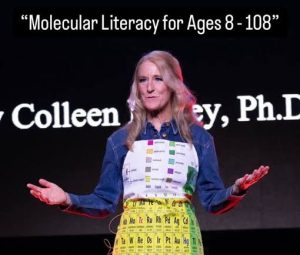
That observation eventually led her away from the lecture hall and into storytelling. Today Kelley is the founder of Kids’ Chemical Solutions and the creator of the M.C. Detective Agency, a series of graphic novels and audio stories that dress up periodic trends, chemical bonds, and molecular structure as clues in a mystery. Her TEDx talk on the subject carries a title that doubles as her mission statement: “Molecular Literacy for Ages 8 to 108.” → the actual talk, https://www.youtube.com/watch?v=OwQfs0pIO-I (TEDxGrandCanyonUniversity)
We asked her how a chemistry professor ends up writing detective stories for children, and why she thinks the textbook approach gets the order of learning backwards.
From bench chemist to storyteller
There wasn’t one single moment, Kelley says, as much as a slow realization built up over decades of teaching.
“Traditional chemistry education often begins with symbols, rules, calculations, and vocabulary before students have any emotional or intellectual reason to care about them. Storytelling changes the order. It gives learners a reason to want the chemistry.”
A story, she explains, can create curiosity, tension, humor, and a question that needs answering before the chemical concept ever shows up on the page. Once a student cares about solving the problem, the chemistry stops being an obstacle and becomes a tool. That idea eventually crystallized into what Kelley calls molecular literacy: the notion that people should learn to read the molecular world the same way they learn to read written language.
“We would never wait until high school to introduce children to letters and words,” she says, “yet we routinely wait until adolescence to introduce them meaningfully to the language of atoms, molecules, formulas, and reactions.”
Why a detective agency
Kelley didn’t land on the detective format by accident. To her, chemists and detectives already have a lot in common.
“Both observe carefully. Both collect evidence. Both look for patterns. Both develop hypotheses. Both revise their thinking when the evidence doesn’t fit,” she says. “The detective framework felt almost inevitable.”
In the M.C. Detective Agency, chemistry becomes the evidence needed to solve a mystery, rather than the day’s lesson plan. Instead of announcing “today we’re learning periodic trends,” the story sets up a problem where understanding periodic trends is what lets the characters figure something out. Molecular structures, formulas, ions, and elements become clues the reader learns to read, rather than symbols someone explains to them years later.
The mystery textbooks kill too soon
Ask Kelley what the real mystery in a chemistry lesson is, and her answer is almost embarrassingly simple: why does matter behave the way it does?
“Why does one substance dissolve and another not? Why do some atoms react eagerly while others barely react at all? Why does chocolate melt in your hand? Why does something change color?” she asks. “Those are wonderful mysteries. But textbooks often answer the question before students have had time to wonder about it.”
“One of the most powerful shifts a teacher can make is moving from ‘here is what happens’ to ‘something happened, what do you notice, what might explain it.'”
Hooking a kid who hates science class
Kelley is direct about what the first page of one of her books cannot do: feel like science class. It needs a character, a problem, something funny or strange, and ideally a moment that makes the reader think, wait, what is going on here.
“I want the reader to enter because of the story and discover later that they have been doing chemistry,” she says. That matters most, she argues, for children who have already decided they are not “science people.” Announce on page one that the book is going to teach them chemistry, and you may have already lost them. Let them help a character solve a mystery and realize partway through that they now understand what an ion is, and chemistry has slipped in through a door that might otherwise have stayed shut.
What works as a story, and what doesn’t
Not every chemistry concept survives the trip into narrative, and Kelley has learned to spot the ones that do. She looks for ideas that already contain relationships, patterns, transformations, or conflict: atoms gaining or losing electrons, reactions where “characters” change partners, periodic trends that double as clues, molecular shape as spatial reasoning, intermolecular forces reframed as questions about attraction.
Audio is a different challenge entirely, since there’s no molecular diagram to fall back on. “The concept has to work through dialogue, sound, imagination, and character interaction,” she says.
She’s also candid about where the format has failed her. “Some chemistry concepts resist being turned into narrative, particularly when I try too hard to make the analogy do all the work,” she says. “I’ve had ideas where the story became so elaborate that the chemistry almost disappeared. When that happens, I know I have gone too far.” Her fix, when it happens, is almost anticlimactic: let the characters actually talk about a molecule, draw it, or reason through it, rather than disguising every scientific idea as something else. “The goal isn’t to hide chemistry,” she says. “The goal is to make learners want to look at it.”
When molecular literacy becomes a child’s own language
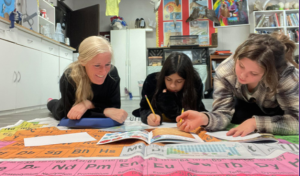
The feedback that sticks with Kelley most is small and easy to miss unless you’re listening for it: a child pointing at something ordinary and asking what its formula is, or looking at a periodic table as though it’s something they’re allowed to explore rather than memorize.
“I once described the periodic table as the alphabet of science. Elements are our letters. Chemical formulas are our words. Chemical equations become our sentences,” she says. “When children begin trying to ‘read’ chemistry on their own, that is tremendously exciting to me, because it means chemistry is no longer something belonging exclusively to scientists. It has become part of their language.”
One free trick for educators and parents
Asked what a parent or teacher could borrow from her approach tomorrow, with no budget at all, Kelley doesn’t hesitate: replace the explanation with a question, at least for the first few minutes.
- What do you notice?
- What do you wonder?
- What evidence do you have?
- What do you think is happening that we cannot see?
That last question, she says, is especially powerful in chemistry, and it works with almost anything already lying around a house or classroom: bubbles, cooking, melting ice, a rusted bicycle, food coloring, soap, a candle, a leaf. “Children are remarkably good scientific thinkers,” Kelley says, “when adults resist answering too quickly.”
What comes next
Kelley sees Kids’ Chemical Solutions growing well beyond a book series into what she calls a larger ecosystem for molecular literacy: more graphic novels, but also audio storytelling, games, family learning resources, classroom materials, teacher professional development, and partnerships that reach children earlier than a typical chemistry curriculum does.
“The larger vision is not simply to produce more chemistry materials,” she says. “It is to help create a generation of children who grow up believing that molecules are something they can read, discuss, draw, question, and understand.” Ultimately, she’d like molecular literacy to become a normal part of childhood science education, rather than something introduced suddenly once students reach a high school chemistry course.
Fast facts: Colleen Kelley and Kids’ Chemical Solutions
- Ph.D. in Chemistry, Penn State University
- Chateaubriand Fellowship at Université Pasteur, Strasbourg, studying under Nobel laureate Jean-Marie Lehn
- More than 30 years as a chemistry professor and researcher in environmental toxicology, medicinal chemistry, and chemical education
- Author of four textbooks and more than 30 peer-reviewed papers
- TEDx talk: “Molecular Literacy for Ages 8 to 108”
- Founder, Kids’ Chemical Solutions
- Creator, the M.C. Detective Agency graphic novels and Emmy-winning PBS content
Explore More at InfoChemist
Interested in how AI is accelerating the design of next-generation sensing materials? Read our analysis on AI in Chemistry to see how machine learning is transforming analytical chemistry from the molecular level up.
