
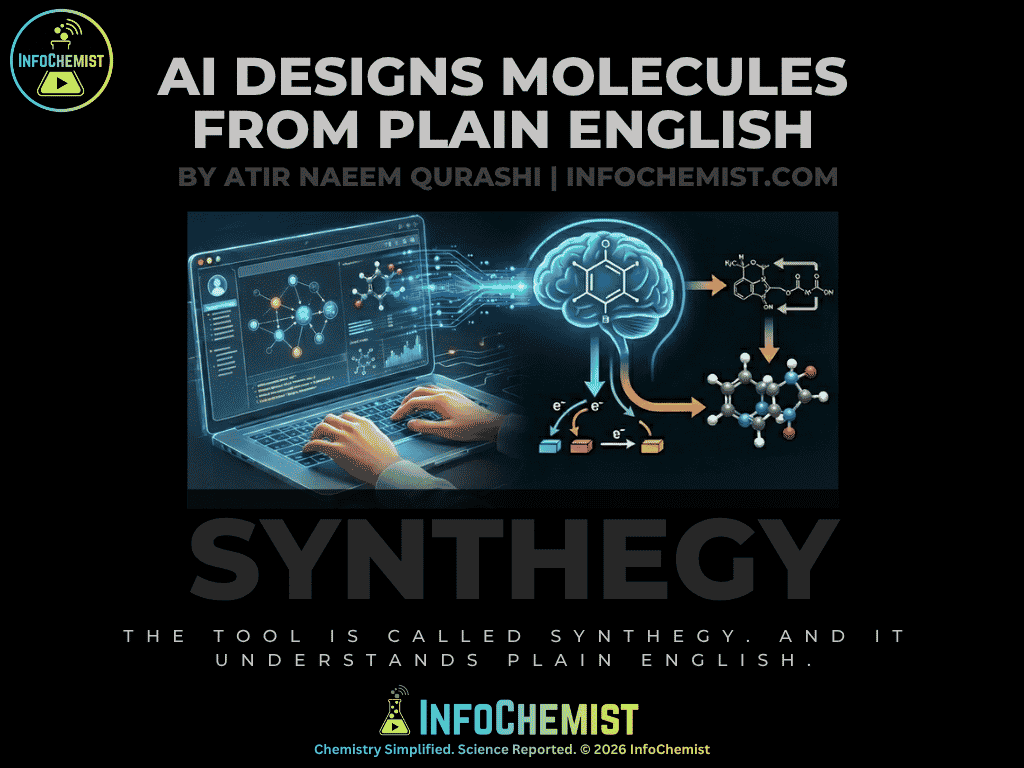
A major breakthrough at EPFL reveals how AI designs molecules and plans complex synthesis routes using nothing but plain English text descriptions. Developed by a research team led by Philippe Schwaller, this new approach uses large language models (LLMs) as reasoning engines for chemistry, promising enormous implications for pharma and materials science. The tool is called Synthegy—and it understands conversational human language.
⚡ Fast Facts
Who: Researchers led by Philippe Schwaller at EPFL (École Polytechnique Fédérale de Lausanne, Switzerland)
What: An AI framework called Synthegy that uses large language models to plan chemical synthesis routes from natural-language text descriptions
Published: Matter journal, April 24, 2026 — DOI: 10.1016/j.matt.2026.102812
Validated by: 36 independent chemists across 368 evaluations, matching expert judgment 71.2% of the time
Why it matters: First system to combine AI chemical reasoning with plain-language input for real synthesis planning
The Two Problems That Stopped Chemistry Cold
Two problems plague much of modern chemistry. The first is retrosynthesis — chemists start from a target molecule and work backward to identify simpler building blocks and viable reaction pathways, involving countless decisions from choosing starting materials to determining when to form rings or protect sensitive functional groups. The second is reaction mechanisms — describing how reactions unfold step by step through the movements of electrons.
Think of it like GPS navigation. Old computational tools could show you every possible road on the map — but had no idea which route actually made sense for your journey. Existing computational methods can generate many possible pathways, but often lack the chemical intuition needed to identify the most plausible ones.
Synthegy changes that by adding reasoning to the search, proving that an advanced AI designs molecules more effectively when it can evaluate its own strategic choices.
How Synthegy Actually Works:
Rather than directly generating chemical structures, these models act as evaluators that guide existing computational systems. The new framework combines traditional search algorithms with AI that can interpret chemical strategies written in natural language.
A chemist types what they want — in plain English. Synthegy then:
Evaluates how well each pathway aligns with the user’s goals, assigns scores, and explains its reasoning.
Breaks reactions into elementary electron movements and explores multiple possibilities.
Allows additional context — reaction conditions, expert hypotheses — to be fed as simple text.
“When making tools for chemists, the user interface matters a lot, and previous tools relied on cumbersome filters and rules,” said Andres M. Bran, lead author of the study.
Why Does This Matter for Drug Discovery?
Because speed in molecule design directly saves lives. A new antibiotic, cancer drug, or biodegradable polymer that previously took a senior chemist months to plan can now be prototyped in hours. Senior researchers — professors and research scientists — agreed with Synthegy more often than PhD students, suggesting the system captures the same strategic intuitions that come with experience.
The system was tested across multiple leading AI models including GPT-4o, Claude, and DeepSeek-r1 — making it model-agnostic and ready for real-world deployment across institutions with different AI infrastructure.
The Real-World Impact
The implications extend far beyond the laboratory bench:
Pharmaceutical R&D: Faster synthesis planning means faster drug candidates entering clinical trials.
Green Chemistry: AI can prioritize low-waste, sustainable synthesis routes when instructed in plain language.
Materials Science: Novel polymers, semiconductors, and nanomaterials can be designed more efficiently.
Education: Chemistry students and early-career researchers gain access to expert-level synthesis reasoning without years of accumulated experience.
In synthesis planning, Synthegy successfully identified routes that match complex strategic requests — and in a double-blind expert study, 36 chemists provided 368 valid evaluations, with their judgments aligning with the system’s assessments 71.2% of the time on average. That figure is comparable to the rate at which expert chemists agree with each other.
The Bottom Line
Synthegy does not replace the chemist. It amplifies one. By translating human intent — written in plain English — into chemically rigorous synthesis strategies, EPFL’s framework represents a genuine leap forward in how molecules are designed, planned, and built.
The era of conversational chemistry has begun.
Want to dive deeper into the technical mechanics, reaction formulas, and datasets behind Synthegy? Read our comprehensive, step-by-step breakdown over at uocs.org:
Explore More in Digital Chemistry: If you found this breakthrough fascinating, read our latest breakdown on AI in Chemistry to see how automation is transforming modern laboratories.
